




BMW E34 Five Series - Problems and Buyer's Guide
Engines

|
Six cylinder 12 valve 2.0 and 2.5 |

|
Six cylinder diesels 2.4 |

|
Six cylinder 12 valve 3.0 and 3.5 |

|
Four cylinder 8 valve 1.8 |

|
Six cylinder 24 valve 2.0 and 2.5 |

|
Six cylinder turbo diesel 2.5 |

|
First modern V8 3.0 and 4.0 |

|
Six cylinder 24 valve 3.6 and 3.8 |
E34 engines were generally a pretty solid and reliable bunch but there are few things to watch out for. Owners of older cars with M40, M20 and M21 engines will need to change their timing belts regularly as a failure will result in major damage, these were all collision engines. In addition M20, M21, M30 and S38 owners will need to have their valves manually adjusted every 30,000 miles to ensure optimum running.
Later engines had one coil per cylinder but on the M40, M20, M30 and S38 3.6 you still have a distributor. I've seen M20s and M30s running with hardly any rotor arm left, but they kept going. Because these parts wear slowly the degradation is hard to spot. But on a friend's M20 we gained 5mpg and a lot more high end power by fitting a new cap and rotor. I'll bet a lot of these cars still have the original parts. HT leads don't last forever either.
M40, M43, M50 and M60s have maintenance free hydraulic tappets. But it's not unknown for them to get very noisy and need bleeding. A low oil level or lots of short journeys can cause it, I've had it on an M52 and N52. The cure is to let the car warm up then whilst parked run the engine at 3000rpm for three minutes.
On the diesels the big danger is coking up with soot and worn turbos, given away by a very oil laden exhaust. Fuel additives and injector cleaners can help with soot build up but the only real way to get rid of it is to remove the intake manifold and clean everything.
M60 V8s had a problem with cylinder bore wear due to high sulphur in fuel. It damaged the Nikasil lining causing low compression, poor idle and a lack of power. BMW replaced a lot of blocks under warranty but it wasn't until the M62 it was sorted out. Today we have low sulphur fuel and if an engine is fine it should stay that way. Any V8 that's lasted until now is likely OK.
The other M60 malady is chain wear, or to be more accurate chain guide wear. The guides are plastic and don't last forever, if an engine seems noisy from the front this may be why. It's possible for a home mechanic to change it but the parts aren't that cheap.
On any four valve per cylinder engine check for oil in the spark plug holes, this is a sign of a failing valve cover gasket. Be careful not to over tighten the bolts holding the valve cover as they're only going into aluminium.
You'll hear a lot of talk about cooling system problems and poor materials. In my experience it can be an issue but is much more common in the US and hotter countries. Having to change a radiator on an old car isn't the end of the world and they're not that expensive if you shop around. Regular coolant changes every two years help a lot.
Thermostats can stick open over time and run below the centre line in the blue zone, the majority of BMWs I've bought did this. Owners didn't seem to care but it can hurt economy and doesn't do the engine much good. Fitting a new one is fairly cheap and not hard.
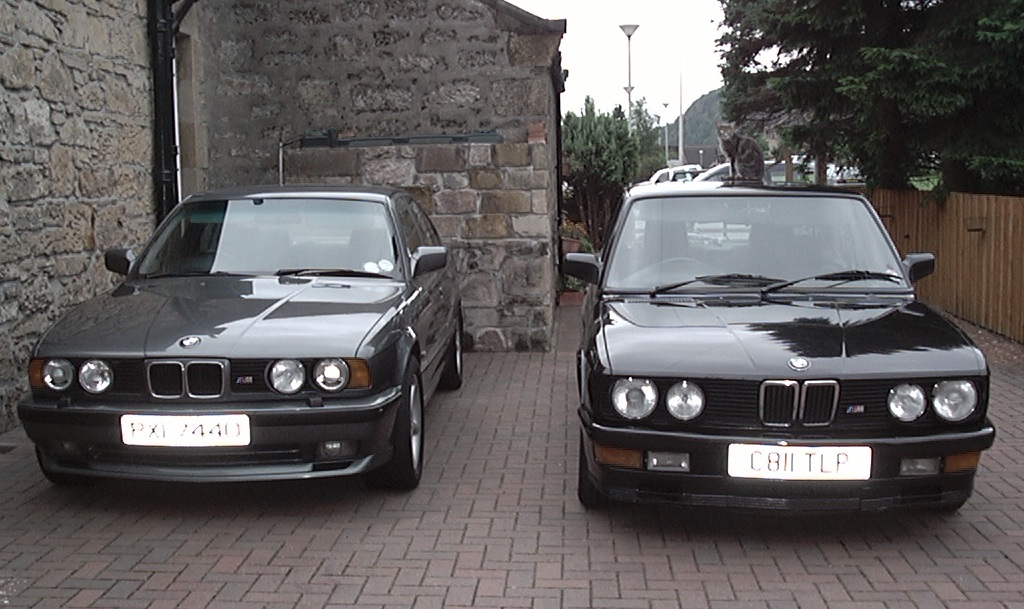
My E28 //M535i and E34 535i Sport.
Suspension & Steering
Suspension is fairly similar to the older E24 and E28 and has the same issues. Vibration at speed or when braking is likely a worn centre drag link, not hard ot that expensive to fix. Worn tie rods won't help either. There's also an idler arm on the other side from the steering box that's worth replacing.
At the rear the semi-trailing arms are held in place by Pitman arms often called "dog bones". Not expensive and well worth replacing. A worn set will see the car feel like it's moving about at the rear. Badly worn subframe bushings can also do this.
It's a mistake to lower an E34 more than about 25mm as the geometry has little adjustment and you'll really upset the camber, especially at the rear.
The steering box wears with age and whilst it can be adjusted to reduce centre play there comes a point where replacement can't be put off. But worn bushings and ball joints should be changed first to rule out other causes. Power steering fluid isn't lifetime, if in doubt change it and clean the filter screen in the reservoir.
Notchy steering might be bad strut top bearings.
Drivetrains
Differential and manual gearbox fluids should be changed every 60,000 miles. If you have a limited slip differential be sure to use the right fluid with friction modifiers.
The four speed ZF 4HP22 automatic needs a fluid and filter change every 30,000 miles. Early versions could kill the A clutch pack if revved hard in park or neutral. It wasn't uncommon to lose forward gears which was the perfect excuse to convert my 635CSi to a manual! By the time the E34 was released a pressure relief modification was made and this reduced the change of failure.
If your automatic is massively overdue for a fluid change if may be wise to leave it alone. Otherwise you risk getting debris into the solenoids and jamming them. On this gearbox the fluid level must always be checked with warm oil. Unlike later cars there is a handy dipstick.
.
TRX Tyres
If you still have TRX tyres it's time to upgrade. Get 16x8" wheels with 225/55/16 tyres. Be sure to use wheels with the right offset, three series wheels are incorrect. If you use wheels from an E39 or later and don't want lots of vibration you need hubcentric adjuster O rings as the hub bore is larger on newer models.
Body
E34s were well made cars but they can and do rust. The most notorious spots are the jacking points. You can buy internal reinforcement plates when it comes time to sort them.
Windscreen wipers can park too low and cause rubbing due to wear in the mechanism.
In terms of electrics you need to watch for a blown heater fan control resistor pack and frayed wiring to the boot lid. There are also fusible links which can crack and cause assorted earth related issues. By now all engine engine earth straps will be returning to nature and should be replaced.
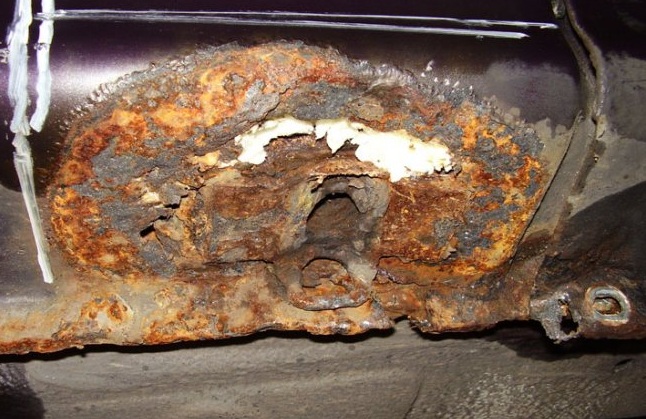
Rusty jacking points.