


BMW E34 Five Series - Model Range
Background
The E34 went all the way from a 118bhp 518i to the 341bhp M5 3.8 monster with many steps in between, just as the E28 had. But whilst the car started with the E28's engines it finished with V8s, VANOS, one coil per cylinder, hydraulic tappets and a raft of other innovations. The E34 was well ahead of the game and stayed that way until the end. In the UK we had the car for an extra year due to a lack of right hand drive E39s.
There were no bad E34s or models to avoid, just cars more suited to some roles than others - horses for courses. It's a shame so many of these great cars are no longer with us because in style and driving pleasure they put many a modern BMW to shame. I'd love to own another one, just one more time.

From the E12 to the present, all the fives.
The Facelift
In September 1992 the E34 received a minor cosmetic facelift. The main changes were the door mirrors which went to the E36 style and the kidney grills (with matching different bonnet) which were widened. Minor changes included revised interior lights and sun visors. Fog lamps went to a projector design but all E34 headlights were projector design from the beginning.
The front doors are different but not by much and I believe they can be swapped with a bit of persuasion. I believe later door handles were plastic but I can't remember ever seeing one. The lock mechanisms certainly were different though.
After the facelift the now five year old model was often fitted with extra equipment to aid its departure from the showroom floor. The cross spoke TRX alloys were common along with side side skirts and //M-Tech under bumpers. Leather was more common although sadly it was often an ivory white variety which aged badly and looks awful when dirty. It was of a lower quality than the "buffalo" leather used on cars like the 535i.
It was also very common to find wood trim instead of the vinyl gear lever surrounds used previously and new interior colours were available too. Airbags started to appear more frequently until they eventually became standard.
Early cars except for the M30 variants often had the battery in the engine bay, even some M50 cars. By the facelift all of them had the battery under the rear seat for better weight distribution.
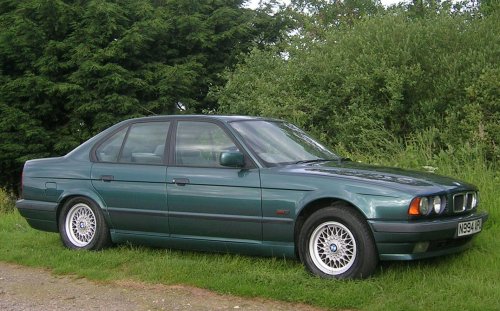
1995 518i with skirts and later style TRX alloys.
518i M40 / M43
I never met a 518i owner who didn't like their car and they sold surprisingly well. Perhaps it was bought knowing it was no drag racer even by those on tight company car budgets. They were never high specification models except towards the final year of production when many got body kits, TRX alloys and all the trimmings left over at the factory. Many a 518i ended up as a taxi and it was a role they were well suited to with build quality that was up to the job.
Initially they used the M40 1.8 8 valve engine, one of my least favourite BMW engines due it's wheezing power delivery and ability to sound like a sewing machine. Add to this the need for regular cambelt changes and it just wasn't much fun for anyone involved.
At the end of 1993 the M43 took over, effectively 1994 model year. The M43 was a chain driven engine with one coil per cylinder, a big step forward. Power and torque were up very slightly but it made peak torque further down the rev range and that helped the big car. It was still no ball of fire but in practical terms it was certainly a worthwhile upgrade.
Today there are loads a 518i's about because the boy racers don't like them. Many have been well cared for and with good higher powered E34s going up in price later cars are an excellent candidate for an engine swap. You can even find them in touring form.
It always amused me how small the engine looked in the E34s huge engine bay, it sits very far forward too. You could get a four speed automatic 518i, even on M43 cars it wasn't five speed but an A4S.
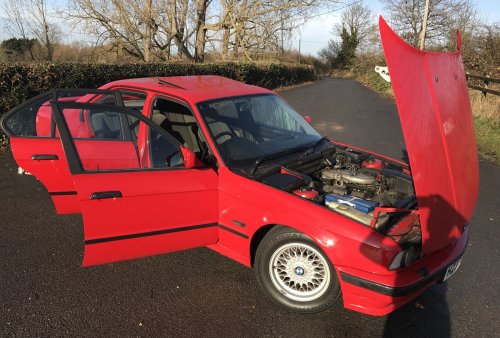
Early M20 based 525i.
520i / 525i Early M20
The M20 12 valve 2.0 and 2.5 engines were both excellent for their time, but they're weren't quite as advanced as the rest of the E34. They had timing belts, distributors and needed manual valve adjustments. They made about 20bhp less than their 24 valve replacements and a bit less torque. As regards the 520i the later M50 cars are almost fast enough but lack the power to overtake comfortably on B roads, the M20 cars aren't. They have an easier final drive ratio to make up for the power difference but this makes them buzzy and more hungry at speed in an engine that's already less fuel efficient than the M50.
The 525i's extra power over the 520i was most welcome then. It was a strong and durable engine if looked after and made the E34 into more of the powerhouse it should have been. But it came at a price and this was higher fuel consumption than an M50 525i.
These cars had four speed automatic gearboxes, the ZF 4HP22 found across most 80's BMWs and a host of other marques. It was a decent unit and with Motronic computer control and its Sports / Economy program it helped make the best of any situation. But compared to the later five speed boxes it's one more argument for getting a 24 valve E34.
If viewed in comparison to the E28 they replaced the new 520i and 525i were a great leap forwards. They used the same M20 engine albeit the nearest E28 to the 525i was the 2.7 525e "eta". But the ride, style and quality were all hugely enhanced. By 1987 the E28 was looking very long in the tooth compared to its rivals whilst the E34 leap frogged the opposition.
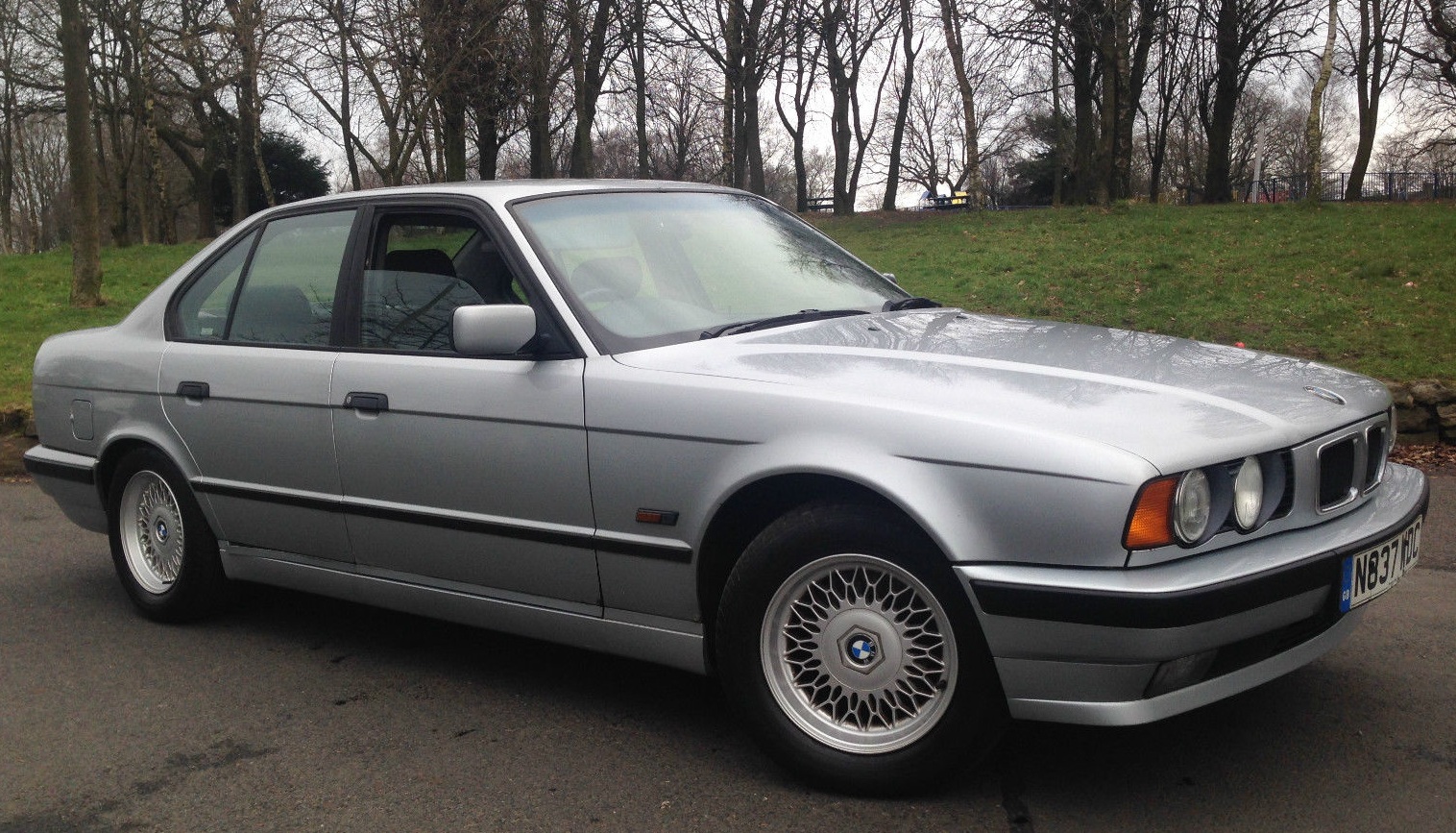
Final year 520i with skirts and TRX 390mm alloys.
520i / 525i Later M50
In January 1989 (March for the 520i) the M50 24 valve replaced the M20 and it was a huge step forward, this is the car to have. The 520i doesn't have quite enough power to cut it but the 2.5 really does. The M50 is a strong engine that loves to rev and the engineers really went to town with it. Anyone who thinks this is a slow car isn't using the top half of the tacho enough.
In addition to needing a lot less maintenance the M50 used less fuel and it's higher final drive ratio made motorway cruising more relaxed. For those who spurned the excellent manual gearbox a new five speed A5S automatic was available and the extra gear made progress even smoother. It's sport mode had smaller jumps between gears so kicked down more readily than on the M20 cars.
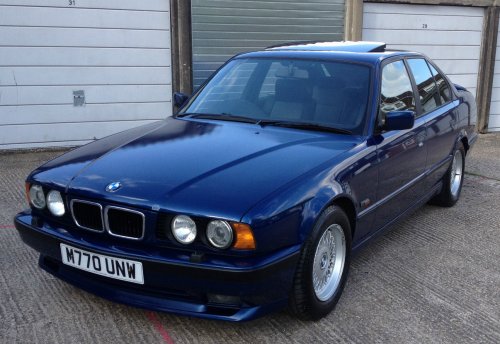
Late model 525i M50 with Sport pack.
A 525i was a great choice that was fun to drive, those who couldn't afford a larger engined E34 had no need to feel short changed. Today they are often far better value.
A Sport model was a very desirable upgrade over the stock or SE (Special Equipment) versions. These came with possibly the best front seats ever to grace a BMW, the supportive and comfortable style pioneered in the E28 and E30. The suspension was firmed up and many had a limited slip differential. The brakes and power were unchanged but a body pack consisting of spoilers and side skirts was fitted.
In late 1992 the M50TU (Technical Update) was introduced with VANOS variable valve timing on the intake camshaft. Power and torque were virtually unchanged but the spread of torque was improved giving more low end grunt.

My friend's 525iX touring barely visible in my driveway.
525iX 4x4
BMW had made an E30 325iX four wheel drive and the car sold well in colder climates, although sadly never in right hand drive. For the E34 an M50 2.5 525iX saloon and touring were offered. This page gives more details on the technical aspect of the four wheel drive system.
There were two revisions of this car and I don't claim to be an expert here. I believe the early model used a limited slip rear differential. The later car had an open diff (with an optional LSD?) and BMW's then brand new ASC+T traction control system. Both could be had as a manual or automatic.
A friend had a manual 525iX touring and nothing Highland winters could throw at it ever stopped it. The four wheel drive system didn't do the fuel economy any good and sapped a bit of the power but it still drove the way an E34 should. I was lucky enough to drive a very rare 3.0 Alpina iX which I think may have been called an "Allrad". The car was a lot slower than my Alpina B10 3.5 but still quicker than a rear wheel drive 525i. A good chunk of the extra power was used in compensating for the extra transmission drag.
The only downside to the iX, then and now, was parts. Brake discs were custom and expensive as were front suspension components. Alpina did a lowering kit so there were upgrade options but they had Alpina prices to match. Differentials and transfer boxes will not be easy to replace if they break but luckily they seem to be reliable.
These car had a unique wheel offset and came with alloys not sold on any other BMW. Fortunately the offset is very close to the E36 / E46 three series so those wheels fit perfectly. But do bear in mind that E34 tyres are larger in diameter. So for 16" wheels you'd want 225/55/16s instead of the 225/50/16s on an E36.

M21 turbo diesel engine in a 524td.
524td M21 Diesel
The M21 turbo diesel was carried over from the E28 and was a strong, reliable unit. BMW invested a great deal of money on their first mainstream diesel engine and when launched there was nothing to touch it. In the E34 it was always the turbo model, unlike the E28 and E30 there was no normally aspirated diesel.
The car was never sold in the UK or USA as there was deemed too little demand for it.
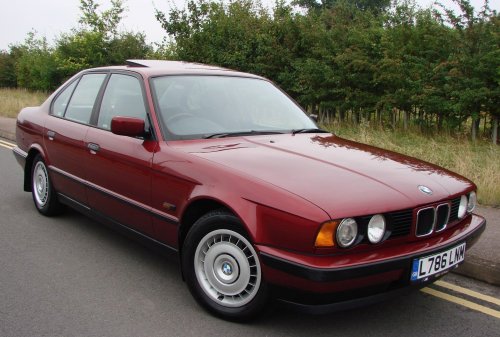
Smart 525tds with later style hub caps.
525td / 525tds M51 Diesel
By the early 90's the idea of the performance diesel was beginning to dawn, in part due to higher fuel prices caused by the first Gulf War. BMW timed the early 1990 european launch of the M51 24 valve diesel in the 525tds perfectly and led the game from the beginning. This engine was lower maintenance, higher power and more fuel efficient than the M21. It had so much low down torque that the new car could use a very tall final drive ratio giving it excellent motorway manners. It was the first real luxury performance diesel that worked and was still sporty to drive, the first of a market sector that is huge today in europe and the UK.
In early 1993 a cheaper 524td joined the tds. This version lacked the intercooler of the existing model and had a less aggressive tune resulting in a 28bhp power loss (143 down to 115bhp).
A surprisingly high number of these cars survive today, like the 518i the boy racers and drifters don't car for them. Many have starship mileages but they can handle it if looked after.
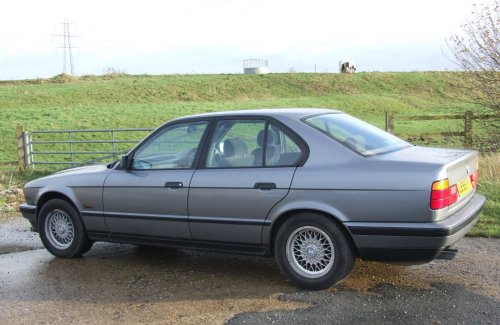
Early 530i with shadowline trim and 15" cross spokes.
530i / 535i M30
530i's and 535i's had the final iteration of the legendary M30 engine, possibly the most iconic engine in BMW history and one that started life in 1968. In 1987 it used the same excellent Motronic computer controlled fuel injection as the E28 version (years ahead of the competition) but benefited from minor upgrades such as the deletion of the cold start injector. Automatic versions used the same four speed ZF 4HP22 tranmission as the older car, which wasn't a problem.
This big 12 valve engined revved with a sporty eagerness that shamed the large engines of other car makers. The 535i's headline power of 218bhp is a poor indication of the real tractability and pulling power of the M30 and it felt much quicker. Even the smaller 530i was a fast car thanks to it's easier gearing and should not be dismissed today.
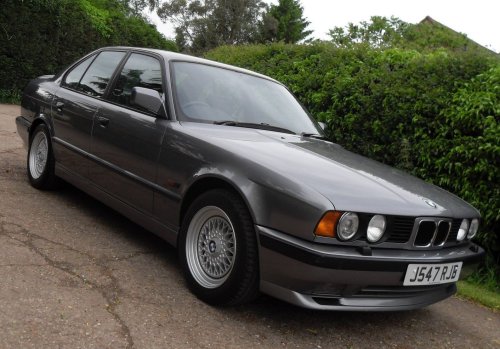
535i Sport with 415mm TRX alloys.
Like the 520i and 535i a Sport model was offered. The 535i Sport was the car to have (and I did). It was the epitome of what the E34 was all about, a luxurious and well built mile cruncher that handled well and looked like a night club bouncer in an expensive suit. It was a car you could grab by the scruff of the neck and power into corners confidently then drive comfortably for 500 miles on a motorway. The nature of the M30 complemented the E34 perfectly. It lost some of the rawness of the E28 M535i and there was no dog-leg gearbox option, but it made up for it with a sense of supreme solidity the E28 lacked.
Many 535i Sports were sold new with 415mm TRX alloys, the Betamax of tyre design. Good in their day and even used on some exotic Italian cars, but even in the mid-80s they were past it and tyre design had advanced. They were originally meant to combine the comfort of a high profile tyre with the handling of a sportier model. These tyres hooked onto the rim differently so to prevent fitting the wrong type they used a metric dimater, 390 or 415mm. BMW put them on the E28 M535i and retained them for the 535i Sport (going from 390 to 415). They look like BBS cross spokes from a distance, the 415s have a black band round the outside. I still have one in my garage somewhere. Even when these cars were new TRX tyres were unduly expensive.
Alpina, AC Schnitzer and Hartge looked upon the 535i Sport and saw that it was good, but they each decided to make it even better. I miss the 80s.
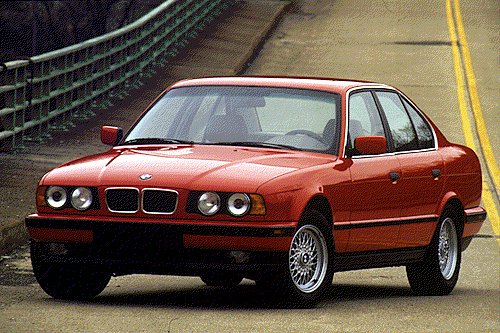
American specification 530i V8, note US headlights.
530i / 540i M60 V8
All good things have to come to an end, although nobody has ever explained why including BMW. And so it was that after 25 glorious years the M30 ceased production. One of the main drivers for this was that the E32 735i was losing a power battle with it's rivals, especially in the American market. There was a V12 750i but it was far too expensive and a V8 was seen as the way ahead, it was only natural the E34 should use the same power plant. Thus the M60 V8 530i and 540i entered production in 1993.
I had an M60 3.0 V8 in my E38 730i and loved it. Even in the big seven it was a very quick and sporty drive, something nobody ever said about the E32 730i M30 (a friend had one so I've driven both). In the lighter E34 the three litre V8 excelled, but in a different way to the outgoing 535i. If was of course a more modern engine and was bit better on fuel but nonetheless the M30 was a very hard act to follow. If you ever get the chance to drive a 535i and a V8 E34 back to back take it, it's analogous to comparing two fine wines.

540i V8 with the revised under spoiler.
But the analogy fades when the 4.0 V8 comes into play. This V8 makes the same power and 20% more torque than an E28 M5! Not only that but the spread of power is better with more available low down, it uses a heck of a lot less fuel too. It's very smooth and ideally suited to an automatic gearbox, sadly the only experience most drivers will ever have.
In the UK six speed manual 540's are a very rare breed and prices have climbed to match. The M5 ended production a few months before the 540i and BMW specced up many of the manual 540i's to rival the //M car even including items such as the Nurburgring active suspension. All 540's had upgraded front brakes and vented rear discs to cope with the power increase.
Unlike the M30 cars there were 530i and 540i tourings and all were outfitted to a high degree making a good one a real find today.
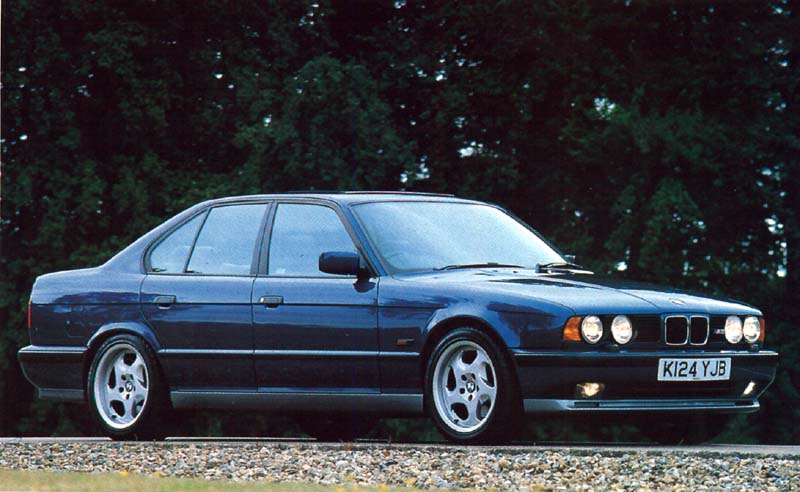
M5 3.8 with two tone paint and "throwing star" alloys.
M5 3.6 & 3.8
The 3.6 and 3.8 S38 powered M5s have their own dedicated page as befits their legend.
American Models
North America got the E34 a year after everyone else in 1988. This meant their E28 528e soldiered on for an extra year and had to get the improved 325i cylinder head as the old one went out of production. BMW struggled to make enough E34s to satisfy demand in europe and even though a Federalised car required far fewer changes than the older model it had to wait.
The US had the 525i (both versions), 525i touring, 530i V8, 535i, 540i and both M5s. The cars were little changed from euro versions except for the lights and more standard equipment. American cars often had tyres with a lower speed rating when new due to the lower US speed limits. I've heard US cars also had American made batteries to satisfy local legislation but this may be untrue.
By now BMW had (finally) gotten used to the US market's different demands and had made a car to cope.